Opera Cake
“The Opera Cake Made Me Fall in Love with My Husband!”
Nutrition Facts
Ingredients
Instructions
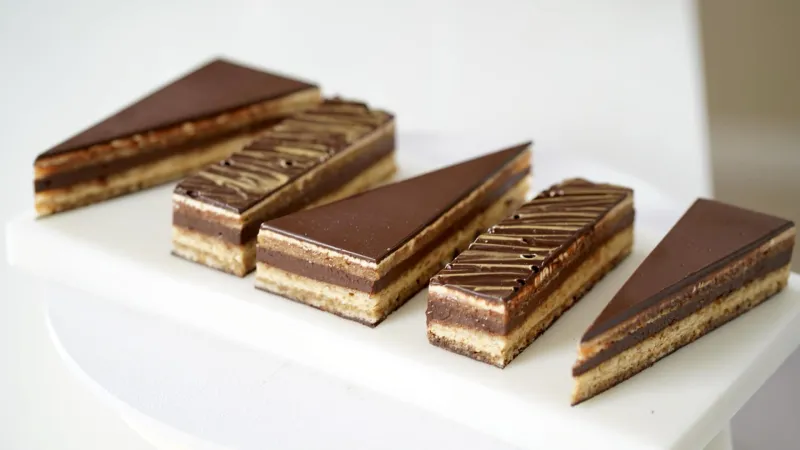
The opera cake can be built using a 13X18-inch/33x46cm sheet pan, or the French Matfer Bourgeat 15 3/4X11-inch/40x30cm mousse set frame. Opera cake is built using 3 layers of Joconde biscuit, heavily soaked in coffee syrup, 2 layers of coffee buttercream and one layer of chocolate ganache. The cake is then glazed with a semi-hard dark chocolate coating. Opera cake shall not exceed 1.25 inches/3.2cm in height. To manage hectic schedules, break down the process into manageable steps. By preparing certain components in advance, you can streamline the final assembly and ensure a flawless outcome. The Joconde biscuit, chocolate ganache, the glaze and the coffee syrup can be prepared days in advance. The day you wish to assemble the cake, make the buttercream and build the opera cake.
The use of gelatin prevents coffee syrup from seeping out of the Joconde biscuit, though it is optional. To use it, soak the gelatin in cold water to soften, then drain and set aside. Bring water, espresso, and sugar to a boil. Remove from heat and add the softened gelatin. Add Nescafé or coffee extract to taste. The syrup should be used at room temperature or lukewarm.
French buttercream is a luxurious filling that has a creme anglaise base, giving it a uniquely rich and custardy texture. To make French buttercream, start by bringing milk to a quick boil along with coffee beans, Nescafe, and vanilla. Cover and let infuse for 30 minutes. This infusion process allows the milk to absorb the flavors of the coffee and vanilla, adding depth and complexity to the buttercream. In a separate bowl, beat egg yolks with sugar. Next, bring the coffee infused milk back to a boil and carefully temper the egg-sugar mixture by slowly incorporating the hot milk into the bowl while continuously whisking. Cook the mixture until it reaches 185ºF/85ºC. Strain it over a mixing bowl, discard coffee beans. Rinse and save vanilla pod. With the whisk attachment, whip the crème anglaise on medium speed. Continue whipping until the mixture cools to 82°F (28-30°C). Then, gradually add the cubed, cooled butter to the cooled custard. Increase the mixer speed to high and beat the buttercream until it is light, airy, and fluffy. Add a few drops of coffee extract to taste, if needed.If the buttercream separates or becomes too soft, here's how to fix it:To fix separation, gently warm the sides of the bowl with a blow torch or place the bowl over a bain-marie for a few seconds. Whip again to emulsify. If it's too soft, place it in the freezer briefly to firm up, then whip again to regain a fluffy texture.Remember, French buttercream should be used at room temperature for the best results.
Melt the chocolate over a water bath, but not completely—it’s fine if some small pieces remain. Meanwhile, bring the heavy cream and corn syrup to a boil. Remove from heat and let stand for 5 minutes. Using a rubber spatula, stir about one-third of the warm cream into the chocolate until combined. Gradually mix in the remaining cream until smooth.Once the ganache reaches 113°F (45°C), add the cubed butter and blend with an immersion blender until the mixture is smooth and silky. For the opera cake, use the ganache while it is still semi-liquid and warm. If it becomes too stiff, gently rewarm it before use.
Chablon (verb: chablonner in French) refers to sealing or coating a sponge cake with a thin layer of chocolate. This technique strengthens the bottom of cakes that are heavily moistened with syrup.To prepare the chocolate coating, melt the chocolate and oil together. Use it at 104°F (40°C). Joconde biscuit sheets can be made in advance.
Lightly oil a baking tray and line it with plastic wrap. Place the first Joconde biscuit (still on its silicone mat) onto a piece of parchment paper. Flip the assembly over and carefully peel off the silicone mat. Cover the exposed side of the biscuit with another sheet of parchment paper and flip it again, so the outer skin (the smooth baked surface) is facing up.Spread the chocolate chablon evenly over the entire surface of the biscuit, then scrape off any excess. Cover with parchment paper and transfer to the refrigerator to set completely. Once set, flip the biscuit and place it chablon-side down into the prepared baking tray. Soak the biscuit with coffee syrup until it is fully saturated. If any excess syrup forms puddles on the surface, gently blot them with a paper towel. Spread the first layer of coffee buttercream evenly, using half of the total amount, and ensure it is distributed uniformly. Carefully place the second Joconde biscuit (still on its silicone mat) onto the buttercream layer, then gently peel off and remove the mat. Soak this layer with coffee syrup as you did the first. Spread the ganache evenly over the soaked biscuit, and top it with the final Joconde sheet (peel off its silicone mat first). Soak the final Joconde layer with coffee syrup, then spread the remaining buttercream evenly over the top. Level the surface of the cake, ensuring it does not exceed the height of the sheet pan. Remember, a finished opera cake should not be taller than 1.4 inches (3.5 cm). Refrigerate the cake overnight. The next day, gently warm a large offset spatula over a flame or in hot water. Smooth the surface of the chilled cake with the warmed spatula, then return it to the refrigerator to set. To remove the cake from the tray, cover it with parchment or a silicone baking mat, place another baking tray on top, and carefully flip the entire assembly.Cut the cake in half and refrigerate it until ready to glaze. Do not freeze it before glazing, as condensation may form on the buttercream and cause cracking.
Chocolate coating—known as pâte à glacer in French, or as compound or chocolate-flavored coating—is an inexpensive chocolate substitute with a higher melting point and a characteristic “waxy” texture. It is made by replacing cocoa butter with less expensive vegetable fat.This type of coating is specifically used in an opera cake glaze to achieve a semi-hard, glossy finish. Opera cake should not be glazed with other types of glaze, such as mirror glaze, which would alter its traditional texture and appearance. To prepare the glaze, gently melt the chocolate coating and stir in the melted fat. Take care not to overheat it.
Melt the chocolate, chocolate coating, and oil together. Pass the mixture through a fine-mesh sieve to ensure smoothness. Gently tap the container to release any air bubbles. Use the opera glaze at a temperature of 104°F (40°C).
📹 Video Tutorial Available! Catch the full video on the original creator's site.
Want to see how it turns out?
We've hidden the final 3 steps to support the original creator. Get the full, complete instructions directly from their site!
Continue Reading at Brunoalbouze →


Comments & Photos
Be the first to share your thoughts!
Reviews from the Original Source
Hello Bruno.
I'm a young subscriber and i wanted to make this cake, but my upside down baking trail is only max. 33x38 cm long.
how do i solve this problem without making the biscuit jocond to thick and to bake it enough?
still, thank you. love your videos and i'm french too.
I have wanted to make this for a long time, and I finally did for Mother's Day. It turned out near perfect and I have never had a reaction like that before! This is by far the most impressive thing I have made. Thank you chef for inspiring me.
Did you make this recipe?
Leave a Comment