Steamed Lotus Root Balls
Steamed lotus root balls is an elegant looking dish suitable as an appetiser or a side dish. It is a slightly sticky ball mixed with prawns (shrimps), gingko nuts and green peas. Pour dashi flavoured sauce over them to eat.You can make vegetarian version of steamed lotus root balls by replacing prawns with other vegetables (see note 7 for suggestions). And use konbu dashi (see Varieties of Dashi Stock).Each ball is about 5cm (2") in diameter.
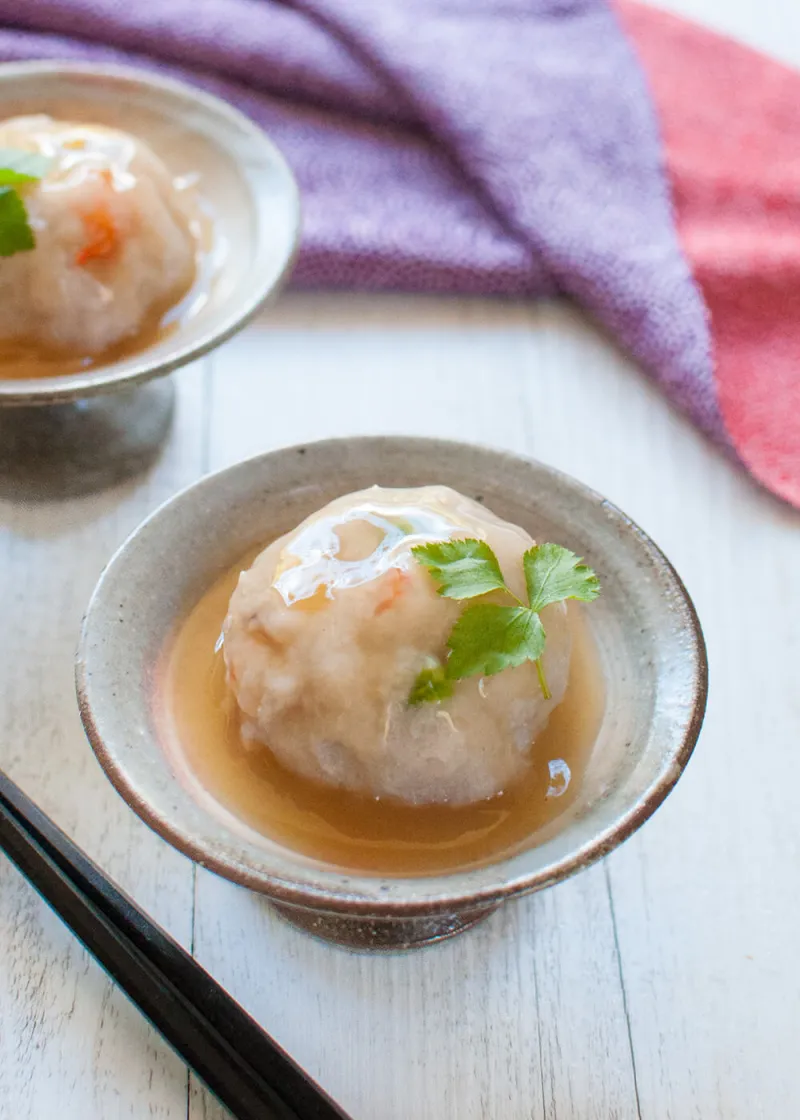
Ingredients
Instructions
Peel the skin of the lotus root and grate very finely (note 5). Put the grated lotus root in a bowl.
Put aside 4 prawn pieces and 4 green peas and add the rest of them to the bowl.
Add a pinch of salt to the bowl and mix well.
Divide the mixture into 4, ensuring that prawns and peas are evenly divided.
Take one portion of the mixture and make a ball. Place one of the reserved prawn pieces, a green pea and a ginkgo nut on the top of the ball, press down gently to embed half way.
Lightly press the ball to flatten a bit and place it on a steaming plate (note 6). Repeat to make 3 more balls.
Want to see how it turns out?
We've hidden the final 3 steps to support the original creator. Get the full, complete instructions directly from their site!
Continue Reading at Japan.recipetineats →Chef's Notes
1. My prawn was 35g (1.2oz) after peeled.
2. Ginko nuts are the fruits of the maidenhair tree. They are widely used in Chinese and Japanese cuisines, in small quantities. In Japan, ginkgo nuts are often added to chawanmushi or grilled on skewers along with yakitori.
I bought a bag of frozen boiled ginkgo nuts from an Asian grocery store (see photo below). You may also find fresh gingko nuts in the shell. You have to cook them either by boiling for 10 minutes or roasting until the shell cracks, then peel the hard shells as well as the brown membrane.
3. I used light soy sauce so that the colour of the sauce becomes lighter. If you don't have light soy sauce, you can substitute with normal soy sauce, e.g. Kikkoman soy sauce.
4. Mitsuba is a wild Japanese parsley or the Japanese version of Cryptotaenia. Japanese grocery stores usually stock fresh mitsuba. But recently, I learnt from my son that Korean grocery stores also sell mitsuba in a large bunch. I bought it recently from a Korean grocery shop in Eastwood and it was great.
Instead of mitsuba, you can use other green leaves such as small mizuna leaves or julienned blanched snow peas.
5. Lotus root will start to oxidise and become greyish as soon as you peel the skin and the flesh is exposed to air. If you are not grating immediately after peeling the lotus root, keep it in water with a small amount of vinegar. It not only prevents the lotus loot from becoming greyish but also makes the lotus root crisp.
6. Instead of steaming lotus root balls on a large plate, you could place each ball on a small serving plate or a bowl individually and steam. You can then serve the dish straight from the steamer.
7. To make vegetarian version of steamed lotus root balls, replace prawns with diced shiitake mushrooms, carrots, edamame and/or corn kernels. edamame and corn need should be pre-boiled. For dash stock, use konbu dashi (see Varieties of Dashi Stock).
Comments & Photos
Be the first to share your thoughts!
Did you make this recipe?
Leave a Comment